Selection & Case Study
Selection case: a compact Mecanum mobile-manipulation baseline
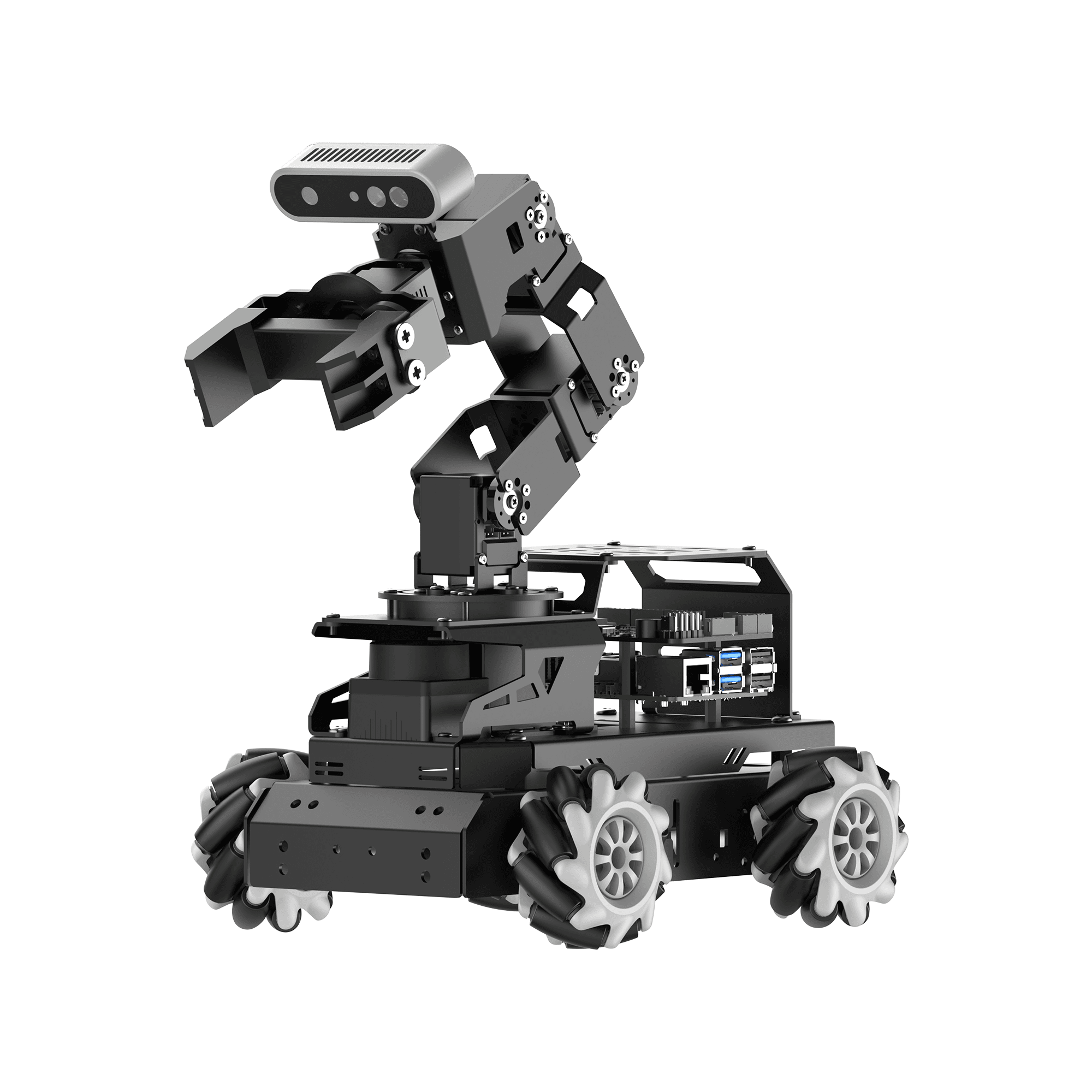
A staged selection and acceptance case for a compact indoor Mecanum platform with a 6-DOF arm, RGB-D perception and ROS 2 host.
The case: move, observe and manipulate on a flat indoor floor
This reference is for a development team that needs a compact robot to translate, rotate, inspect a nearby object and perform light, supervised pick-and-place research on a firm indoor surface. It is not an outdoor, stair-climbing or safety-rated production robot.
The useful first milestone is modest: the base can move in a measured coordinate system, the arm can make bounded bench-validated motions, and the camera can show repeatable local RGB-D observations without asking every subsystem to solve every problem.
Reference product roles
HW-LANDERPI-MECANUM-BASE supplies the all-metal four-wheel chassis with encoder-geared motors and 45-degree Mecanum rollers. It needs a compatible four-channel encoder-motor controller, regulated drive power and flat, reasonably firm ground.
HW-LANDERPI-6DOF-ARM contributes a six-servo arm and gripper; it needs its own protected 6–8.4 V servo rail and half-duplex UART controller. HW-RPI5-8GB hosts ROS 2. HW-AURORA930-PRO provides local RGB-D observation. HW-RRC-LITE can serve as the real-time controller layer after firmware and harness confirmation.
Why the base and arm are accepted separately first
Mecanum roller slip can affect odometry, especially when the arm changes the center of mass. The arm reference payload and reach are not guarantees at every pose on a moving base. Combining them before either has a stable baseline creates failures that are hard to separate.
First validate encoder signs, wheel arrangement, IMU convention and conservative planar motions. Separately validate servo IDs, joint limits, protected power and bench motion. Only then establish the arm-to-base transform and begin stationary coordinated tests.
Perception and geometry choice
Aurora930 Pro is useful when the task needs aligned local depth, colour and infrared information around a work area. Its published 640 × 400 @ 12 fps streams and 0.3–3 m engineering planning range are starting points, not a grasp success guarantee.
Rigid camera mounting, a measured camera frame, known lighting and calibration/transform records matter more than adding a perception model early. Test object material, glare, occlusion and camera placement with the intended gripper poses.
Acceptance gates
Gate one: power and controller stability with no motion. Gate two: individual Mecanum wheel and encoder tests. Gate three: IMU/odometry and short planar paths. Gate four: arm bench motion in an empty workspace. Gate five: RGB-D stream and frame validation. Gate six: stationary arm motion over a stable base.
Only after these gates may a team run low-speed base motion with the arm stowed, then introduce one simple coordinated behavior under direct observation.
When to choose a different architecture
Choose a tracked or suspension base if the route is not a flat, firm indoor surface. Choose a different arm or add safety infrastructure if the payload, speed, reach, people proximity or collision consequences exceed the stated planning limits.
The result of this case is a clear feasibility boundary, a purchase list and a test plan—not a claim that every mobile-manipulation task can be solved by one compact configuration.
Ready to turn the method into specific parts?
Browse the parts catalogue